The relentless march of technology, particularly in fields like artificial intelligence and high-performance computing (HPC), has pushed modern processors to incredible new heights. While this power fuels innovation, it also generates extreme heat within a very small space. This thermal challenge is one of the most critical issues facing the data center industry today, and the old methods of cooling are no longer enough.
High-density computing environments can quickly overwhelm traditional air-cooling systems. Racks packed with powerful GPUs and CPUs can generate heat loads exceeding 50 kW, 80 kW, or even 100 kW. Trying to manage this with cold air alone is like trying to cool a furnace with a desk fan — it's inefficient, expensive, and unsustainable. This is why the industry is pivoting toward advanced liquid cooling solutions.
At Ardent Data Centers, we recognize that the future of computing depends on mastering thermal management. We have focused on implementing two of the most advanced and effective technologies available: direct-to-chip liquid cooling (DLC) and rear door heat exchangers (RDHx). These aren't just incremental upgrades; they represent a fundamental shift in how we design and operate data centers for the next generation of technology.
The rise of high-density computing challenges
Before diving into the solutions, it's important to understand the challenge. High-density computing refers to deploying a large amount of compute power in a small physical footprint. This is the standard for AI model training, big data analytics, and scientific research.
The primary challenge is thermal density. When you pack dozens of powerful processors into a single server rack, the heat they produce is concentrated. Traditional air-cooling systems, which rely on computer room air handlers (CRAH) to flood the data hall with cold air, struggle to remove this heat effectively. This leads to several problems:
- Hot spots: Pockets of super-heated air can form around racks, leading to equipment failure.
- Thermal throttling: To prevent overheating, processors automatically reduce their performance, which negates the investment in high-end hardware.
- Energy inefficiency: A significant portion of a data center's energy bill comes from cooling. Overworking CRAH units to combat high heat loads drives up operational costs and carbon footprint.
The most effective way to overcome these barriers is to bring cooling closer to the source of the heat. This is where liquid cooling excels.
Direct-to-chip cooling (DLC): Precision cooling at the source
Direct-to-chip liquid cooling is one of the most efficient methods for managing extreme heat loads. As the name suggests, this technology targets the hottest components within a server — the processors (CPUs and GPUs) — directly.
How DLC works
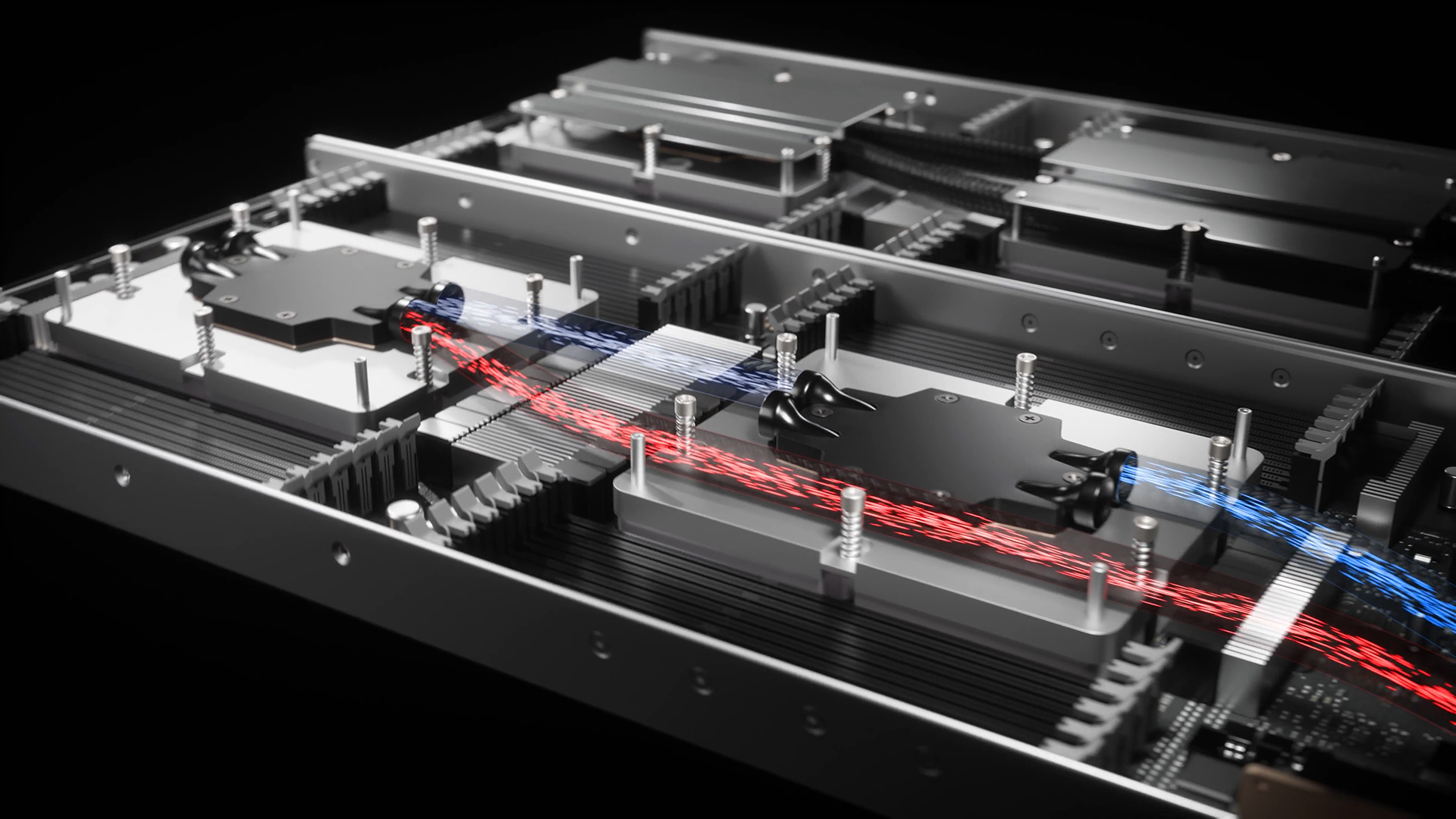
The mechanics of DLC are elegant and effective. A cold plate, which is a metal block with internal micro-channels, is mounted directly onto the processor. A non-conductive fluid is circulated through these channels, absorbing heat from the chip with remarkable efficiency.
This heated liquid is then piped away from the server rack to a cooling distribution unit (CDU). The CDU acts as a heat exchanger, transferring the heat from the server coolant loop to the facility's main chilled water supply. The now-cooled fluid is then recirculated back to the servers to repeat the process.
The technical benefits of DLC
The impact of implementing DLC is profound. By capturing up to 80% of the server's heat directly at the source, it offers several key advantages:
- Superior thermal management: DLC can dissipate hundreds of watts of heat from a single chip, allowing processors to run at their maximum clock speeds without the risk of thermal throttling. This ensures organizations get the performance they paid for from their hardware.
- Increased rack density: Because DLC is so efficient, data centers can support much higher rack densities. Racks that would be impossible to cool with air alone become manageable, allowing for more compute power per square foot.
- Enhanced Energy Efficiency: Liquid is thousands of times more effective at transferring heat than air. By using DLC, data centers can significantly reduce their reliance on energy-intensive CRAH units. This lowers the facility's overall Power Usage Effectiveness (PUE) and reduces operational expenses.
Rear Door Heat Exchangers (RDHx): Rack-level heat neutralization
While DLC is perfect for targeting individual components, sometimes a broader approach is required for entire racks of high-density equipment. This is where rear door heat exchangers (RDHx) provide an excellent solution.
How RDHx works
An RDHx unit replaces the standard rear door of a server rack. It contains a large passive or active coil filled with chilled water. As the servers' internal fans push hot exhaust air out of the back, this air is forced to pass through the heat exchanger coil.
The chilled water in the coil absorbs the heat from the air. The result is that the air re-entering the data hall is at or near room temperature. The RDHx effectively neutralizes the entire heat load of the rack before it can mix with the ambient air.
Integrating RDHx into Data Center Environments
One of the great advantages of RDHx technology is its ability to be retrofitted onto existing racks, making it a versatile upgrade. For new builds, it can be part of the initial design to create high-density zones.
Key benefits include:
- Containing high heat loads: RDHx is capable of removing 100% of a rack's heat load, supporting densities up to and beyond 150 kW per rack, depending on the model.
- Eliminating hot aisles: By cooling the exhaust air at the rack level, RDHx prevents the creation of hot aisles. This improves the overall data center environment for the professionals overseeing operations and reduces the strain on the primary air-cooling system.
- Reduced operational costs: By handling the bulk of the cooling duty at the rack, RDHx allows data center operators to raise the temperature setpoints for the main CRAH units. This simple adjustment can lead to significant energy savings.
Industries benefiting from advanced liquid cooling
The need for advanced cooling solutions is not uniform across all industries. Certain sectors that rely on intensive computation are the primary beneficiaries:
- Artificial intelligence and machine learning: Training large language models (LLMs) and other complex neural networks requires immense, sustained processing power. DLC is almost a necessity for these workloads.
- Scientific research and HPC: Institutions involved in genomics, climate modeling, and particle physics simulations rely on supercomputers that generate massive amounts of heat.
- Financial services: High-frequency trading and risk analysis algorithms require maximum performance, where even microseconds of thermal throttling are unacceptable.
- Media and entertainment: 3D rendering and visual effects studios use powerful GPU farms that can be effectively cooled with either DLC or RDHx solutions.
The Ardent advantage: A holistic approach to cooling
What sets Ardent Data Centers apart is not just offering these technologies but engineering our facilities around them. We understand that advanced cooling is not an add-on; it's a core component of a modern data center. Our AMS1 facility, for example, was built with power and cooling infrastructure to support these solutions at scale.
Our commitment is to provide a platform where innovation is not limited by thermal constraints. By offering both Direct-to-Chip and Rear Door Heat Exchanger solutions, we give our clients the flexibility to choose the right technology for their specific application, ensuring optimal performance, efficiency, and scalability.
The future of computing is powerful, and it will be liquid-cooled. As you plan your next high-density deployment, consider how your infrastructure partner is addressing the thermal challenge. The right cooling strategy is no longer just an operational detail — it's a competitive advantage.
